Wat Arun: visiting and understanding the Temple of Dawn
วัดอรุณราชวราราม
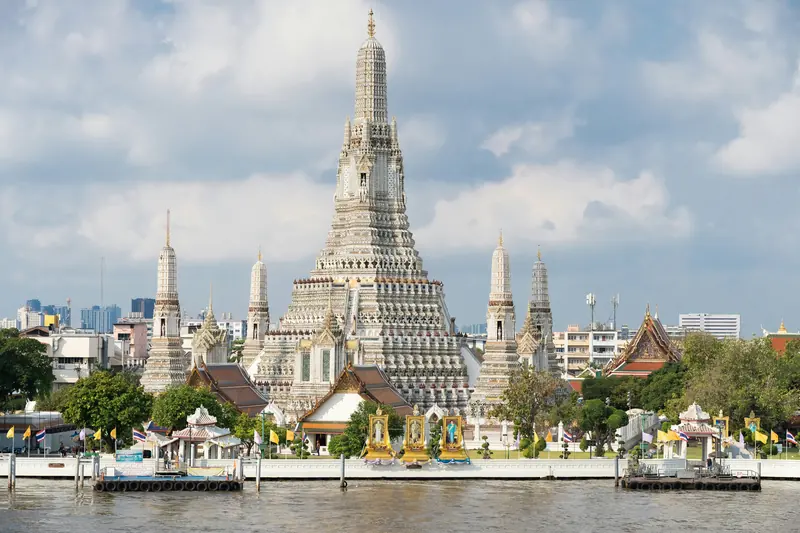
Wat Arun is the temple you see from the river: a tall tower covered in porcelain on the west bank of the Chao Phraya. Use it to plan the visit, then again on site as a short route to follow on your phone.
The main tower is a prang, a tall Khmer-style tower reinterpreted in Thai architecture. It is worth a slower look: the porcelain, the figures that seem to hold up the tiers, the view back across the river.
On this page 14
A · Plan my visit
The essentials
- Entrance
- 200 THB for a foreign adult, according to the Tourism Authority of Thailand (TAT).
- Hours
- 08:00 to 18:00 every day, according to TAT. TAT gives no last-entry time, so do not plan to arrive at closing time.
- Time to allow
- Our estimate: one hour to an hour and a half inside, plus the river crossing and any wait for the boat.
- What to wear
- Cover your shoulders and knees. This is the usual rule in Thai temples, so check the signs at the entrance.
- Getting there
- Usually the cross-river ferry from Tha Tien, the pier next to Wat Pho; confirm it is running. Details below.
- Status
- The main tower was added to Thailand's UNESCO Tentative List on 9 April 2025, the first step towards World Heritage status. It is not a World Heritage Site.
To confirm on the day
The fee and hours above come from TAT and can change. Whether the ferry is running, its fare, the boat frequency, the time of the last entry and whether the upper terraces of the main tower are open are not published in the sources we checked, so this page gives no figure for them.
Getting there from Tha Tien
Wat Arun is on the west bank, and the easiest approach is by water. Go to Tha Tien pier (N8), the stop for Wat Pho, then take the ferry across the river to the Wat Arun landing. Confirm at the pier that the ferry is running. The Getting around page explains the river boats and how they fit with the BTS Skytrain and the MRT.
- Take a Chao Phraya Express boat to Tha Tien (N8). Check first that your line runs that day: the lines are not all daily, as the Getting around page explains.
- If you arrive by MRT, Sanam Chai station is on the Rattanakosin side (the old royal district around the Grand Palace and Wat Pho); check the walk to the pier on a map.
- At Tha Tien, follow the signs for the cross-river ferry. The landing on the other side is at the temple itself.
A taxi or ride-hailing car can also take you to the temple on the Thonburi bank, but the river approach is worth taking for the view as the ferry crosses.
Morning or late afternoon
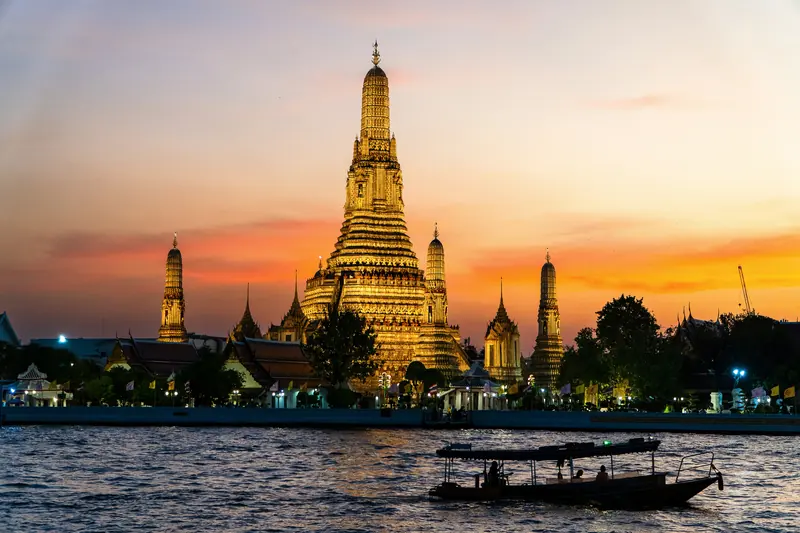
We have not confirmed the orientation. If the temple does face the river, to the east, the morning sun falls on the front of the tower, and from the other bank the tower stands against the evening sky. The sun sets almost directly behind it only around March and late September: from November to January it goes down to the left of the tower, to the south-west, and from May to July to its right.
In practice, if the orientation is as above, go in during the morning, when the front of the tower is lit. Come back to the river bank, or take the boat, at the end of the afternoon for the colour. Because the temple opens at 08:00, you cannot be inside at sunrise, whatever the name suggests.
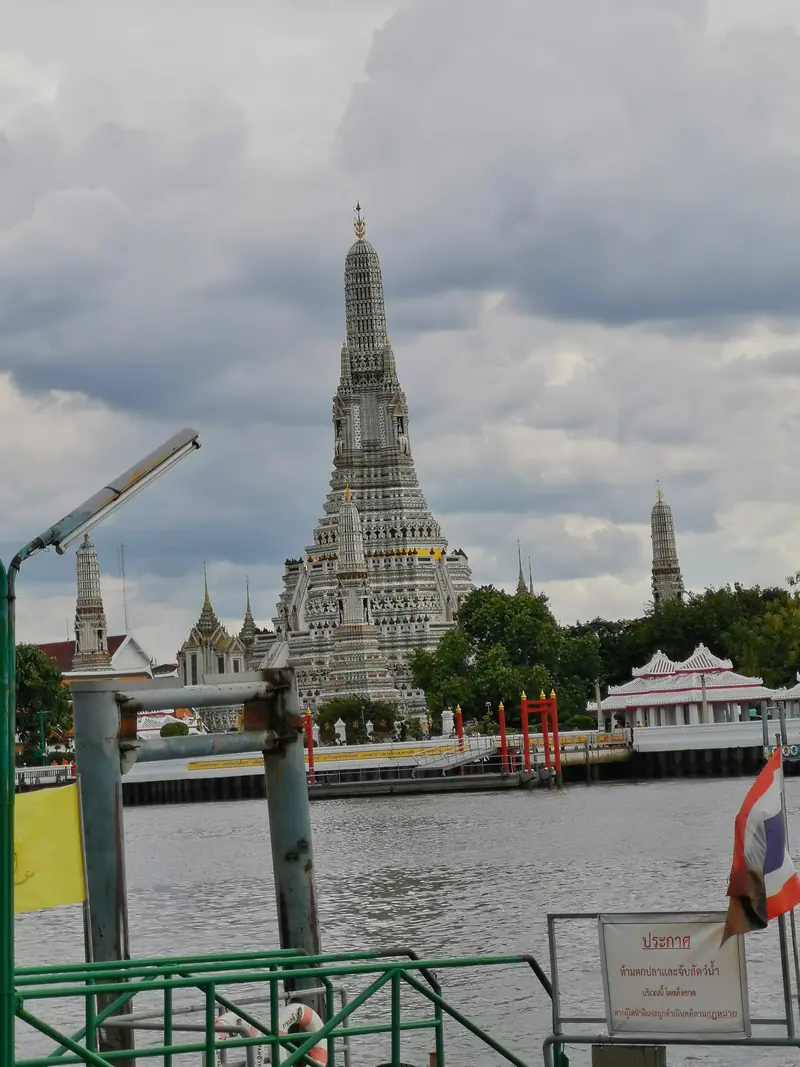
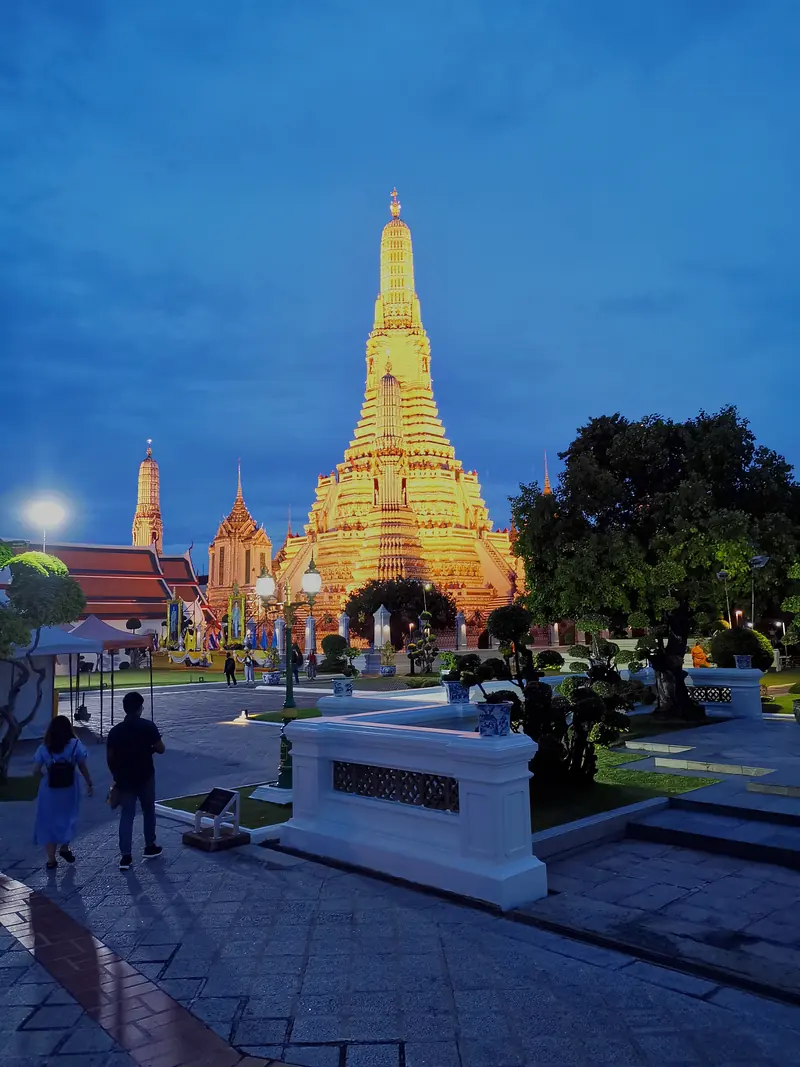
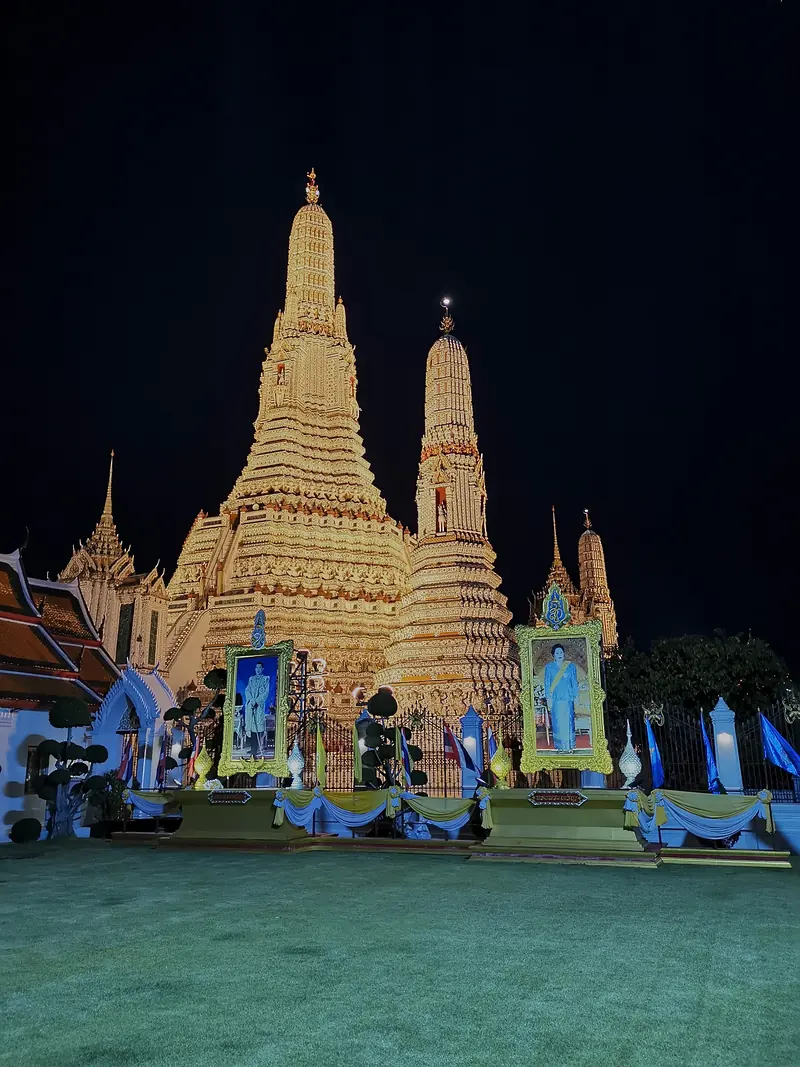
See the gallery for the same tower by day, at blue hour and lit at night.
After Wat Arun
The ferry takes you back to Tha Tien, beside Wat Pho. The Grand Palace is also on the Rattanakosin bank.
If you stayed for the evening light, finish with a walk along the river rather than a rush for the ferry.
Explore the Thonburi canals too
This boat trip with a visit to Wat Paknam ends near Wat Arun. See the tour page for the meeting point, route and conditions, and our Thonburi canals guide to compare the other ways to visit.
To see Wat Arun with the Grand Palace and Wat Pho on a guided tour, two formats exist: a small group of ten at most, guided in English, or a shared or private tour with an audio guide in 41 languages. Our tours page compares them.
B · I'm on site
A simple route, step by step
This route needs no account, no extra app and no location sharing. It follows what the photographs below show; the order is a suggestion, not an official circuit.
- Start at the foot of the main tower. Look up before you photograph anything, to take in the proportions.
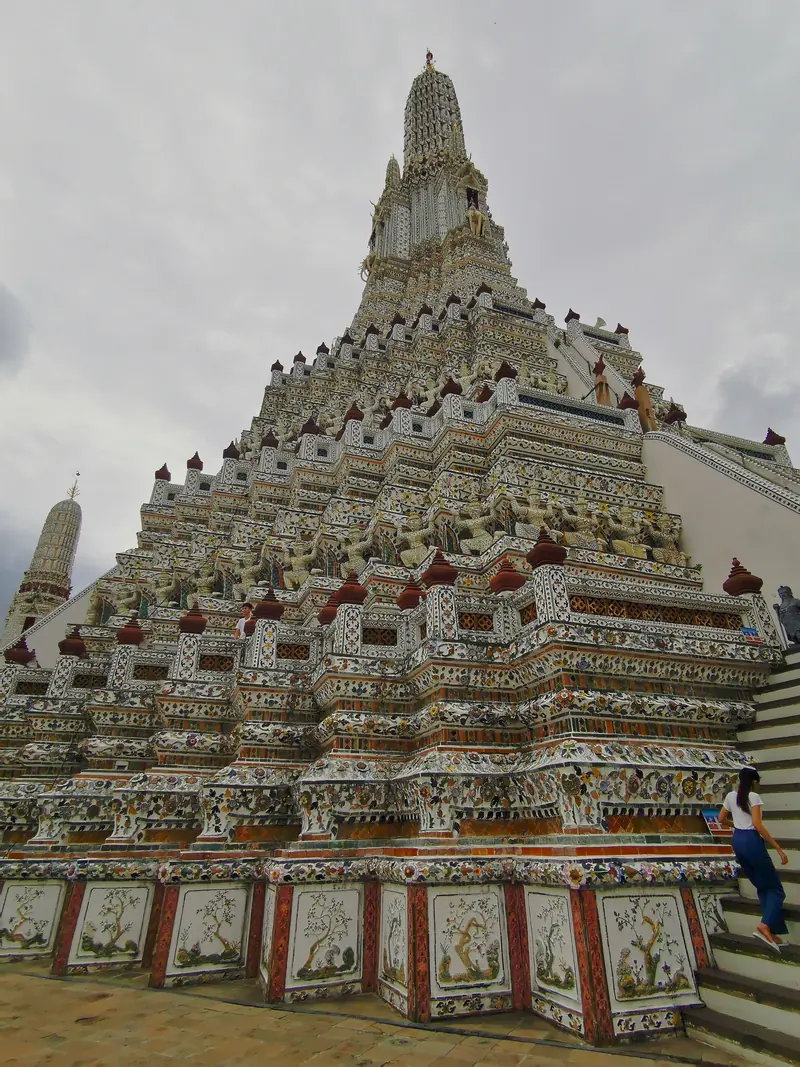
- Walk slowly along the base. The surface is made of small pieces of coloured porcelain set into plaster, forming flowers and patterns.
- Look at the tiers above the panelled base. Rows of figures appear to hold up the structure.
- Find the four smaller towers at the corners. They echo the main tower and frame it.
- Move to the temple halls and gates. Look for the large guardian figures and the layered roofs. Follow the rules of any hall you enter, and take your shoes off where the signs ask.
- Choose your views from the lawn or, if they are open, from the upper terraces. Stay out of areas that are roped off.
- Leave by the river. Take a last look at the tower from the landing before the ferry.
Respect the place
Wat Arun is an active temple. Keep your voice low, do not touch the decoration, and do not climb on anything not meant to be climbed. Ask before photographing monks.
The main tower and its porcelain
The surface of the main tower is covered with pieces of porcelain, usually described as Chinese, and with shell. It sparkles in sunlight and looks paler under cloud.
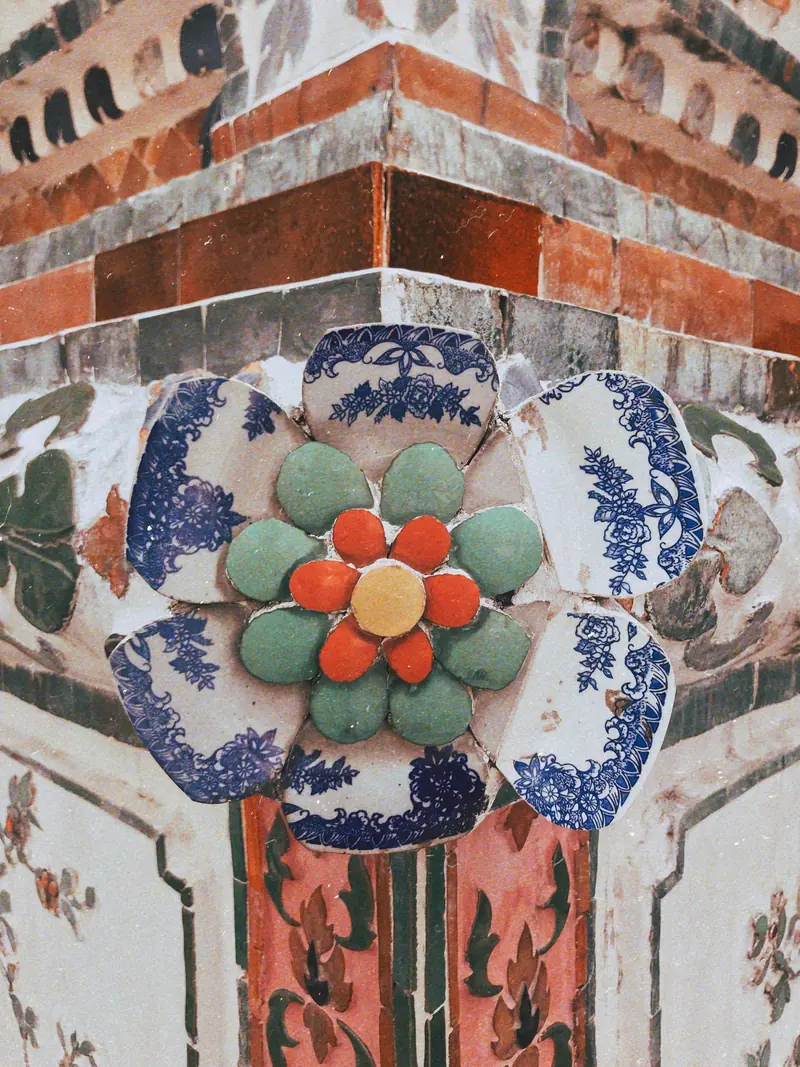
A common explanation is that the porcelain came from Chinese trading ships, which carried it as ballast. We have not verified this.
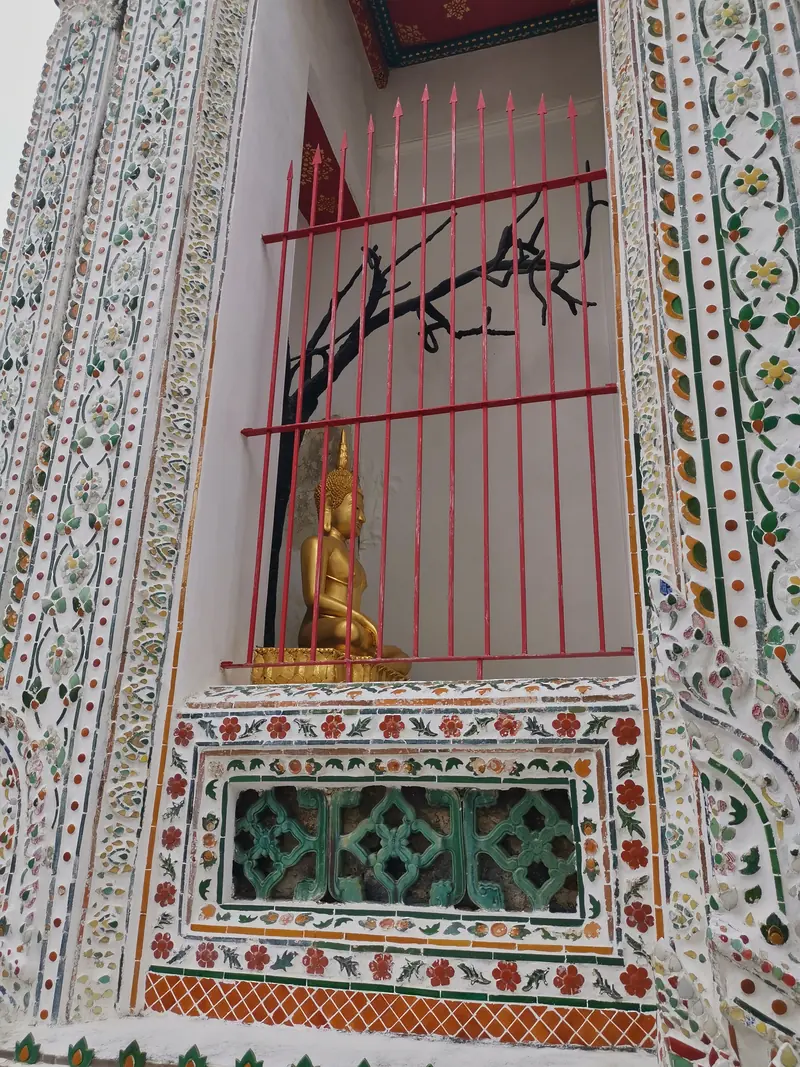
The smaller towers and the figures
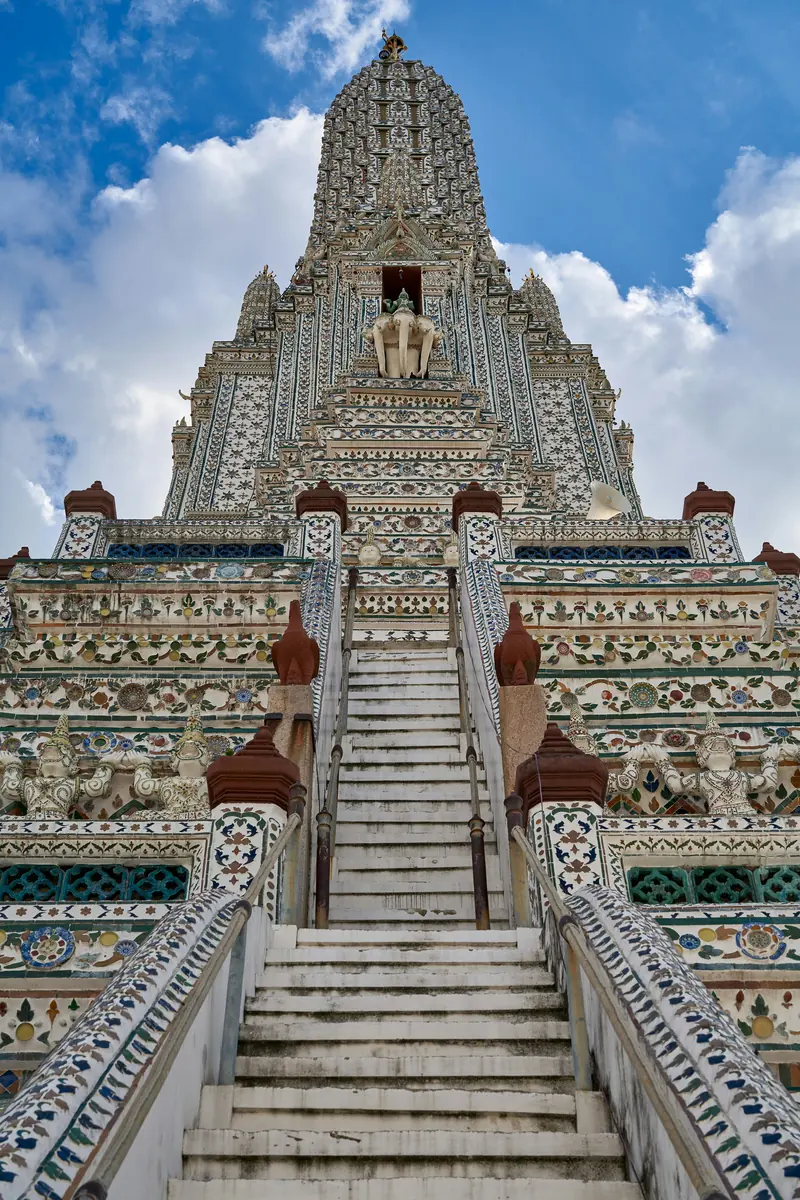
Four smaller towers stand at the corners of the platform. They repeat its decoration at a smaller scale and make the composition read as one group rather than a single tower.
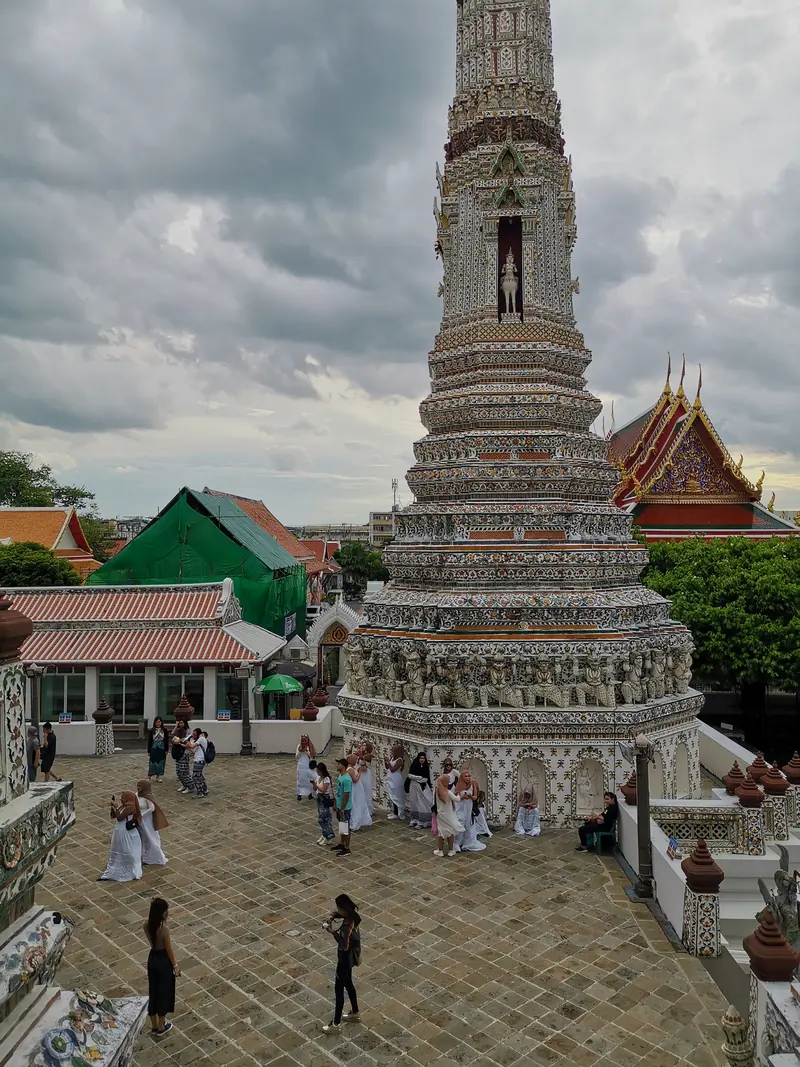
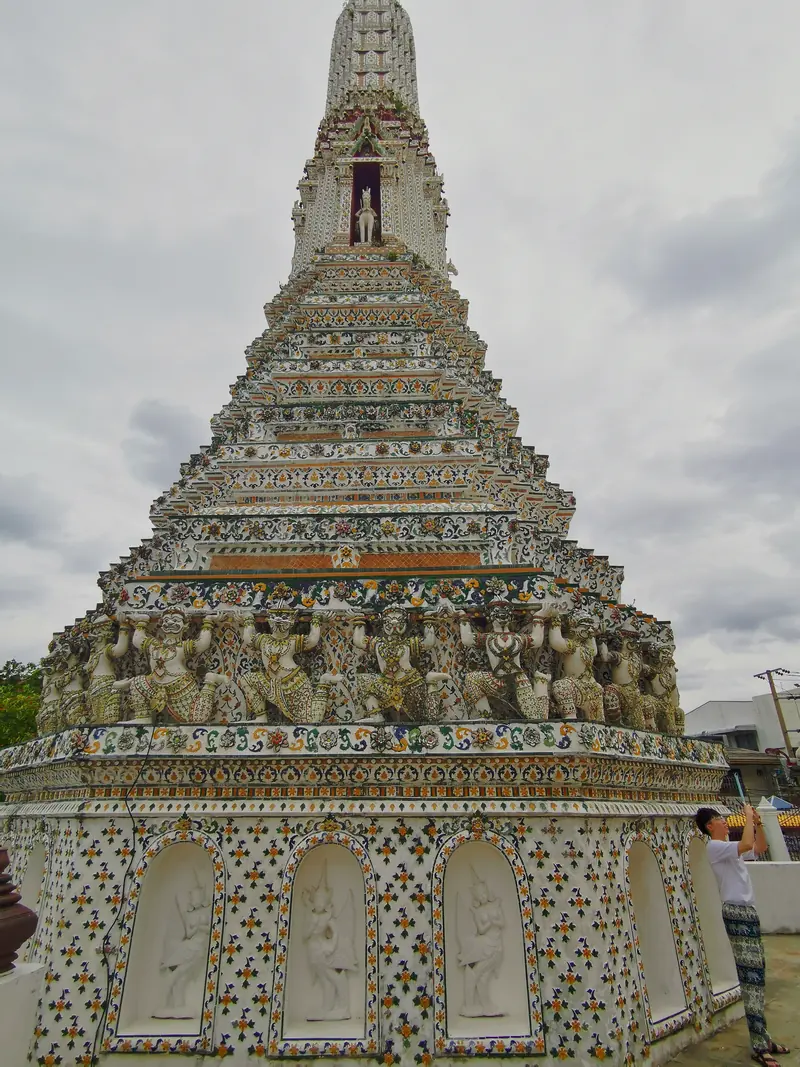
Guardians and religious buildings
Away from the tower, Wat Arun is still an active temple. Look for the guardian figures at the gates and for the roofs of the halls, with their stacked tiers and orange tiles.
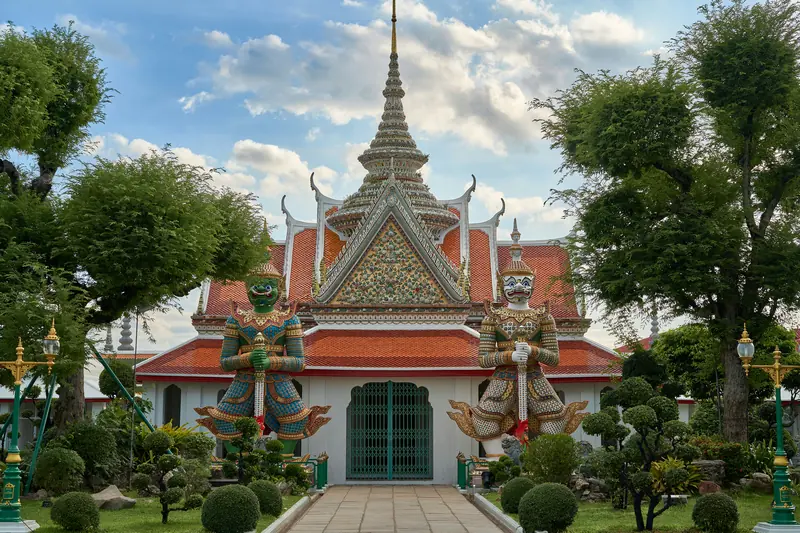
Some halls are for worship. Take your shoes off where the signs ask, do not point your feet at a Buddha image, and do not step on thresholds.
Where to look from
There are three kinds of views, and each needs a different position.
- From the ground, close to the base: the porcelain and the tiers, at their most detailed.
- From the open lawn in front of the tower: the whole group, with the smaller towers around it.
- From the river or the opposite bank: the tower as a landmark, best near sunset.
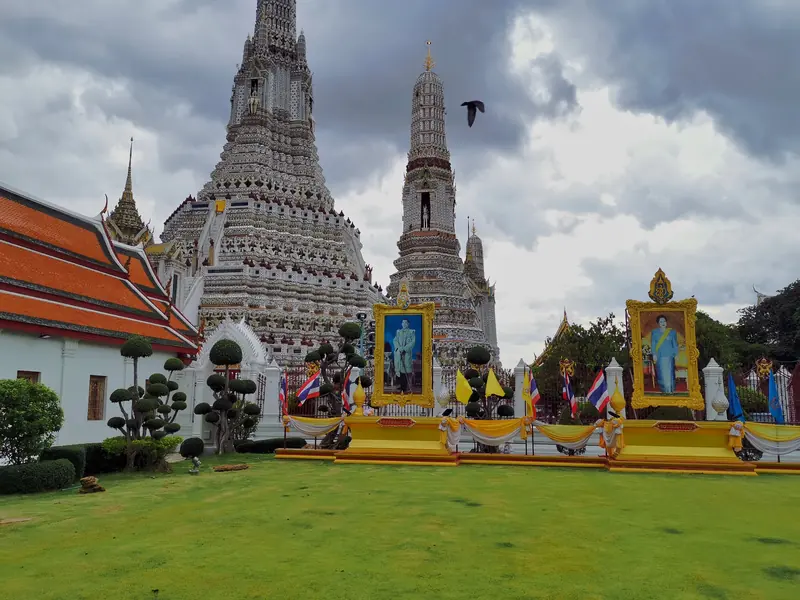
Stay on open paths and out of roped areas, and be careful not to block stairs or doors when you stop for a photo.
A logical way out, to the river
Finish at the river. The landing is where the ferry returns to Tha Tien: take a last look up at the tower from there.
A short history
According to Wikipedia, the temple already existed when Ayutthaya, the old capital, fell in 1767. King Taksin then made Thonburi, on this same bank, his capital, and the temple took the name Wat Chaeng, from a Thai word for dawn. The present name, Wat Arun, the Temple of Dawn, uses another word with the same meaning.
The same source says the Emerald Buddha was kept here for a time before moving to its present home, Wat Phra Kaew, in the grounds of the Grand Palace across the river. Rama I, who founded the Chakri dynasty that still reigns, moved the capital to the east bank, and the temple was no longer beside the royal palace.
The tall tower dates from the nineteenth century and was built in stages by later kings of the same dynasty. Rama II began to enlarge the main tower, Rama III continued the work, and it was completed under Rama IV, who also ordered further restoration and construction, according to the UNESCO Tentative List entry.
The tower as a mountain
The UNESCO Tentative List entry reads the main tower through the symbolism of Mount Meru, the mountain at the centre of the world in Buddhist and Hindu cosmology. In that reading the tiers are the levels of that world, the smaller towers frame the summit, and the figures at the base carry its weight. It is an interpretation of the architecture, not a text written on the building.
Day, blue hour and night
The same tower looks very different depending on the hour. Three of these photographs date from 29 August 2019 and the sunset view is by another photographer: they show what the light can do, not today's visiting conditions or lighting hours.
Questions people ask
Is Wat Arun a UNESCO World Heritage Site?
No. On 9 April 2025 the main tower (known in Thai as Phra Prang) was added to Thailand's Tentative List, the first step of the process. That is not a World Heritage inscription.
Can I climb the main tower?
We do not know: none of the sources we checked says which stairs or upper terraces are open. The photographs show steep stairs; ask at the ticket desk.
How much does it cost?
200 THB for a foreign adult. Fees can change: confirm at the ticket desk.
Can I see Wat Arun without going in?
Yes. The tower is visible from the river and from the opposite bank.
Is it worth going at night?
Not inside, if the published hours apply: the temple closes at 18:00. For the evening view, stay by the river or on the opposite bank; whether the tower is lit is not confirmed. Our night photographs date from 2019 and say nothing about current access or lighting.
Sources
- Wat Arun Ratchawararam RatchawaramahawihanTourism Authority of Thailand (TAT)Entrance fee for a foreign adult and opening hours.
- Phra Prang of Wat Arun Ratchawararam, Tentative ListUNESCO World Heritage CentreEntry on the Tentative List (9 April 2025), with the description of the main tower (Phra Prang), its symbolism and its construction.
- Wat ArunWikipediaGeneral history of the temple before the nineteenth century. A secondary source.
- Sunrise and sunset times in Bangkoktimeanddate.comSunset direction month by month: west-south-west from November to January, west-north-west from May to July. Read on 16 November 2026.